Presales Process for Real Estate Developers in India
A qualified lead with a confirmed site visit sat in the CRM for four days because two teams each thought the other owned it. Here is the six-stage presales process, with an owner and a deadline written against every stage.
Written by The IndiaCalling.ai team · We build AI voice sales agents for Indian real estate developers, working directly with presales teams and portal leads.
Monday morning, nine days into a launch on Golf Course Extension Road in Gurugram. A buyer's enquiry for a four-bedroom unit has been sitting in the CRM since Thursday evening: qualified by presales, a site visit done, a cost sheet shared, then nothing. Presales thinks sales owns the file from the visit onward. Sales thinks presales still owns it, because no visit-outcome note was ever filed against the lead. The buyer, who has since walked a show flat on the same corridor with a competing project, has stopped answering calls from either side. Nobody on this file made a bad call. There was a process on paper with six stages, and not one of those stages had an owner written down anywhere. That gap, not any single mistake, is what lost the booking.
What are the stages of a real estate presales process in India?
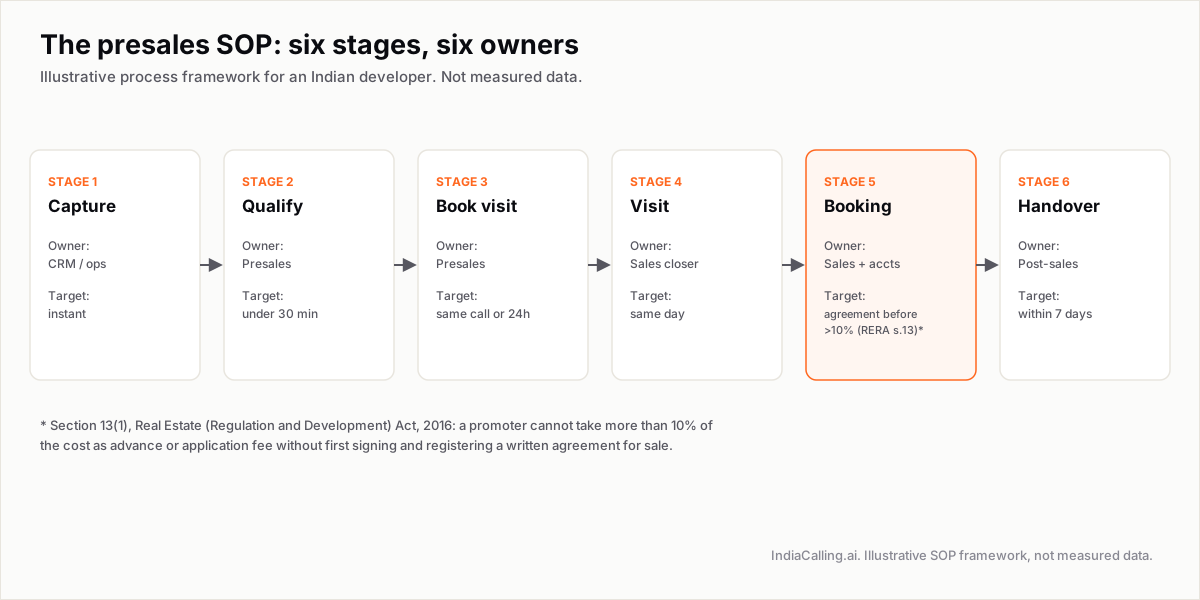
Six, in sequence: lead capture and routing, first contact and qualification, site visit booking, the visit itself with negotiation, booking and token collection, and handover to post-sales or the CRM team. Most presales heads can recite all six from memory. Far fewer have written down, for each one, who owns it, how long it should take, and what has to be true before the file is allowed to move on.
The presales SOP: owner and target time for each stage
Stage
Owner
Target time
Moves on when
1. Capture and routing
CRM / marketing ops
Instant, automatic
Lead is tagged with source, project and campaign, and assigned to a caller or queue
2. First contact and qualification
Presales caller
First attempt within 30 minutes
Budget band, configuration, timeline and decision-maker are confirmed and logged
3. Site visit booking
Presales caller
Same call, or within 24 hours
A specific date and time sits on the calendar, not "will confirm and let you know"
4. Visit and negotiation
Sales closer
Same day as the visit
Buyer has seen the unit, discussed price and payment plan, cost sheet shared
5. Booking and token collection
Sales closer + accounts
Within the scheme's stated validity window
Token received and a registered written agreement for sale signed before more than 10% of cost changes hands
6. Handover to post-sales / CRM
Post-sales / CRM team
Within 7 days of booking
Full file transferred: agreement, payment schedule, documentation checklist
A generic version of stages 1 to 6 appears on most sales-process blogs. The owner and target-time columns, and the exit condition on stage 5, are the parts the generic versions leave blank.
The presales SOP, stage by stage. Illustrative process framework, not measured data.
Why does a presales process break down even when every stage exists on paper?
Because a flowchart naming six boxes and a CRM pipeline tracking six stage labels are not the same thing as an SOP. A stage label tells you where a lead is. It does not tell you whose job it is to move the lead forward, by when, or what signal proves the handoff happened. The Gurugram file above sat for four days exactly in the gap between stage 3 and stage 4: "qualified and visited" was true in the CRM, "assigned to a named closer with a deadline" was not a field anyone had filled in.
This is a staffing-size problem as much as a discipline problem. A two-person presales desk gets away with verbal handoffs because the same two people talk every hour. A desk running three presales callers, two closers and a separate post-sales coordinator across two active towers cannot run on memory, and most developers scale the headcount long before they scale the handoff rules. The CRM stays the same five stages it was configured with on day one; the team triples.
What breaks first, and what does it cost?
Two specific failure points account for most of the damage: the handoff from qualification to visit booking, where a "yes, interested" gets logged without an actual date on the calendar, and the handoff from visit to negotiation, where a closer assumes presales already shared the cost sheet and presales assumes the closer will. Both failures look identical from the outside: a file that stops moving, a buyer who stops answering, and a CRM report that still shows the lead as open because nobody marked it lost.
The cost compounds with volume. A developer running 150 fresh leads a week loses the odd file to this gap without noticing; a developer running 1,500 a week during a launch loses dozens, and the sales head finds out only when the booking numbers come in soft against the visit numbers, weeks after the window that mattered has closed.
What is the fix for each stage, in one sentence?
Six fixes, one per stage, none of which needs new software to start, though most need a system to hold once the desk is past a handful of leads a day.
1. Capture and routing: tag the source before the lead reaches a human
A lead from a channel partner, a 99acres enquiry and a Meta click need the same six qualifying questions but a different opening line and a different urgency read. Tag the source, project and campaign at the point of capture, automatically, so the caller's first sentence is never a generic "thank you for your interest."
2. Qualification: put a clock on the first attempt, and write the clock down
Thirty minutes for the first dial attempt is achievable for most desks and is far from instant, which is exactly why it has to be written down and measured rather than assumed. A desk that believes it already does this and has never pulled the timestamp gap from its own CRM export is the single most common gap in this whole SOP.
3. Site visit booking: a date on the calendar, never a promise to confirm
"I'll check and get back to you" is where a qualified lead quietly stops being a visit. Offer two named slots on the qualifying call itself, book whichever the buyer picks into an actual calendar, and treat an unbooked "interested" lead as still inside stage 2, not stage 3, no matter what the buyer said.
4. Visit and negotiation: the cost sheet moves with the file, not with memory
Attach the exact cost sheet, floor plan and payment-plan version shown to that buyer to the lead record at the moment of the visit, not after. A closer who has to ask presales what was already discussed loses the only advantage a second conversation has: continuity.
5. Booking and token: no money beyond 10% without the paperwork in motion
This is the one stage where the fix is a legal requirement, not a process preference, and it is covered on its own below.
6. Handover to post-sales: a checklist, not a verbal "it's done"
A seven-day handover deadline with a fixed checklist, signed agreement, payment schedule, buyer documents, RERA disclosures, beats an open-ended "post-sales will pick it up," because an open-ended handover is where a booked buyer's first six months of experience with the brand quietly starts going wrong.
What does Indian law actually require at the booking stage, and why do most presales guides skip it?
Section 13(1) of the Real Estate (Regulation and Development) Act, 2016 is specific and binding: a promoter cannot accept more than ten percent of the cost of a unit as an advance payment or application fee from a buyer without first entering into a written agreement for sale and registering that agreement under the applicable law. Most presales-process content, including the highest-ranking pages on this exact query, describes stage 5 as "collect the token, issue a booking form" and stops there. None of the pages we read in full for this piece mentions that the 10% ceiling is a hard statutory gate, not a best practice, or that accounts and sales need a documented trigger for when the agreement has to be signed and registered relative to each payment milestone.
Practically, this means stage 5 of the SOP needs a second owner working alongside the closer: whoever in accounts tracks collections against the 10% threshold has to be able to stop a collection, not just record it, if the agreement for sale is not yet signed and registered. A booking stage written as a single box on a flowchart hides exactly this dependency.
How is IndiaCalling.ai different from a telecaller desk, an IVR or chatbot, or a DIY voice platform running this SOP?
The six stages above do not need an AI agent for stages 4, 5 or 6: negotiation, token collection and documentation handover are judgment and paperwork, done by people. Stages 1 through 3, capture, first contact and visit booking, are exactly where speed and consistency decide whether a lead survives long enough to reach a human closer at all, and that is the part a telecaller desk, an IVR, a DIY platform and an AI voice agent each handle differently.
Who can hold stages 1 to 3 of this SOP, and when
Telecaller desk
IVR or chatbot
DIY voice platform
IndiaCalling.ai
Calls every lead within 30 minutes
Only while staffed and not backlogged
Answers instantly but cannot qualify
Depends on what you build and maintain
First call inside 30 seconds, any hour
Books a specific visit slot, not a promise
Depends on the individual caller's discipline
Can offer a fixed menu, cannot negotiate a time
You design that logic yourself
Offers named slots and books the calendar directly
Available nights, weekends, festivals
Only if someone is on shift
Yes, but cannot qualify or book
Depends on what you built
Yes, same first-call standard at any hour
Hands the closer a complete, logged file
A note typed later, if at all
A click log, no qualification detail
Whatever fields you build
Every call recorded and transcribed, with outcome
Writes the handoff back to the CRM
Manual entry, inconsistent under load
A timestamp only
Needs integration work
CRM write-back to Sell.Do, LeadSquared, Salesforce or Zoho
Descriptions of other categories are general characterisations, not claims about any named product. IndiaCalling.ai entries reflect our published product pages.
What it does not do: negotiate price or payment terms, decide whether a buyer's documentation is in order, or replace the accounts check against the Section 13 threshold. It runs stages 1 to 3 on every lead, at the same standard, so the closer who inherits the file at stage 4 is working a buyer who was called in 30 seconds and offered a real slot, not chasing a lead that went cold while waiting for a human to be free.
From a live client
IndiaCalling AI has become an extension of our sales team. It handles repetitive customer conversations with consistency, allowing our staff to focus on closing deals instead of answering the same questions repeatedly.
Drushika Real Estate · Indore
Back to the Gurugram file. The fix the sales head actually made was not a new tool, it was a one-page addition to the CRM: a mandatory "assigned closer" field that cannot stay blank past the visit date, and a 7-day handover timer that escalates to the sales head if it is not cleared. Neither cost anything. Both exist because the four-day gap finally got named for what it was, a missing owner on a stage everyone assumed someone else was covering.
If your CRM can show you where a lead is but not whose job it was to move it, that is the SOP gap this piece describes, not a staffing problem you can hire your way out of. See how the IndiaCalling.ai agent runs the first three stages on every lead, or book a walkthrough against your own pipeline.
What are the stages of a real estate presales process in India?
Six: lead capture and routing, first contact and qualification, site visit booking, the visit and negotiation, booking and token collection, and handover to post-sales or the CRM team. The stages themselves are not the hard part; naming an owner and a deadline for each one, and writing down what proves a handoff happened, is what most developers skip.
How long should presales take from first enquiry to a booked site visit?
On a well-run desk, the first call happens inside 30 minutes of the enquiry and the visit is booked onto a specific date inside the same call or the following day. A lead that is "qualified and interested" for several days without a date on the calendar has not actually reached stage 3, whatever the CRM label says.
Who should own the handoff between presales and the sales closer?
Name a specific closer against the lead at the moment the visit is confirmed, not after the visit happens. An unnamed handoff is the single most common place a qualified, visited lead stalls, because both teams assume the other is tracking it.
What does RERA require before a developer can collect a booking amount?
Section 13(1) of the RERA Act, 2016 bars a promoter from accepting more than 10 percent of a unit's cost as an advance or application fee without first signing a written agreement for sale and registering it under the applicable law. Accounts should be able to stop a collection past that threshold if the agreement is not yet in place, not simply record the payment.
Can a small developer run this SOP without an AI voice agent?
Yes, if the volume is low enough that two or three people can track handoffs verbally and the owner is willing to check the CRM for stalled files personally. The SOP starts needing automation at stages 1 to 3 once lead volume outpaces how fast a human desk can dial, qualify and book within the target times, which for most developers happens well before they notice it happening.
See it work on your own leads
Book a 30 minute call and we will show you an AI sales agent built on your projects and your numbers.